

Case StudyCustomer: Parker HannifinIndustry: Industial ManufacturingTechnology: Stratasys FDM
July 21, 2026Case StudyCustomer: Stratasys DirectIndustry: ManufacturingTechnology: Post Processing
September 9, 2026Environment, Health & Safety Concerns in the Post-Processing of Additively Manufactured Parts
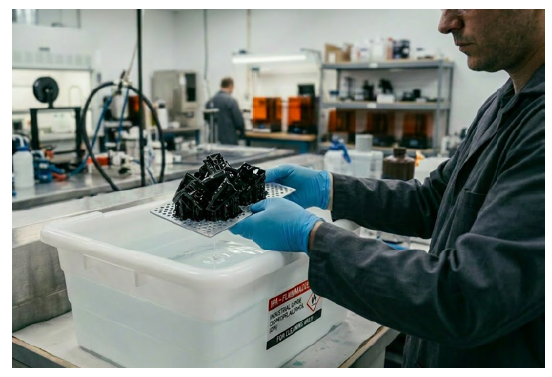
As additive manufacturing (AM) adoption matures and shifts toward higher-volume production, post-processing remains one of the most challenging factors affecting scalability, cost, quality, workforce efficiency, and environmental, health & safety (EH&S) performance. With the growth of AM across aerospace, defense, medical, automotive, and industrial sectors, the focus has shifted beyond printing speed and material capability. Many organizations now recognize that a printed part is only partially complete until supports are removed, surfaces are finished, and the component is cleaned for downstream use.
he Additive Post-Processing Survey: Trends Report continues to identify post-processing as a major bottleneck as AM scales toward production, with growing attention on safety, sustainability, and regulatory readiness.
Traditional post-processing workflows rely heavily on manual labor, hazardous chemicals, and open-air environments that Post-Processing Survey: Trends Report 2026 introduce significant risks to operators and facilities. From operator exposure to volatile solvents to the generation of massive waste streams, conventional post-processing equipment presents a fundamental challenge to achieving safe and sustainable 3D printing at scale. While these methods may appear safe and low-cost initially, they often incur hidden costs due to safety incidents, labor intensity, inconsistent quality, and waste.
Conventional post-processing setups are commonly decentralized and labor-intensive. Operators may move parts among multiple stations for washing, rinsing, support removal, drying, and inspection. In many facilities, chemical tanks remain uncovered, ventilation is inconsistent, and material handling is repetitive.
Research has been conducted on the hazards of additive manufacturing, identifying inhalation exposure to volatile organic compounds (VOCs), exposure to harmful resins and solvents, fire/explosion risks with powders and flammable detergents, and ergonomic stress during loading/unloading and maintenance. Many articles and studies have been done with PMC, CDC, CDC/NIOSH, CCOHS, and Wayne Research detailing these risks.
For companies scaling AM production, these risks become significant as higher throughput means more chemicals, more handling, more operators, and more opportunities for workplace incidents.