

Case StudyCustomer: Stratasys DirectIndustry: ManufacturingTechnology: PostProcess
June 10, 2026Case StudyCustomer: Parker HannifinIndustry: Industial ManufacturingTechnology: Stratasys FDM
July 21, 2026How Artificial Intelligence is Transforming Additive Manufacturing
At Prototyping Solutions, we’re seeing increased interest from manufacturers who want to understand how AI can improve their additive manufacturing workflows. Whether it’s optimizing part designs or improving process monitoring, AI is becoming a valuable tool for organizations looking to accelerate innovation.
Artificial Intelligence (AI) is rapidly becoming one of the most influential technologies shaping the future of manufacturing. While additive manufacturing (AM), commonly known as 3D printing, has already revolutionized product development and production processes, the integration of AI is unlocking new levels of efficiency, quality, and innovation.
Together, AI and additive manufacturing are creating smarter manufacturing environments that enable companies to design better products, reduce costs, and accelerate time-to-market.
Smarter Design Through Generative AI
One of the most impactful applications of AI in additive manufacturing is generative design. Engineers can define performance goals, material constraints, and production requirements, then use AI-powered software to evaluate thousands of potential design solutions in a fraction of the time required by traditional methods. The result is highly optimized components that often reduce weight, improve performance, and minimize material consumption. Rather than replacing engineering expertise, AI enables engineers to explore more possibilities and make better-informed design decisions.
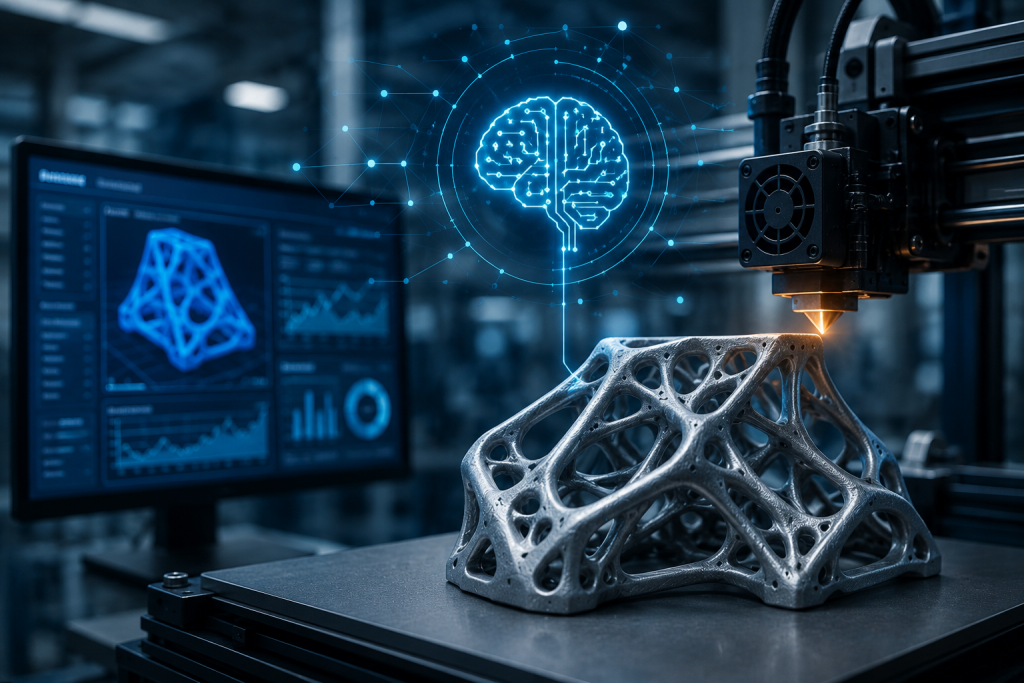
These designs frequently result in:
- Reduced material usage
- Lighter-weight components
- Improved structural performance
- Faster product development cycles
Industries such as aerospace, automotive, and medical device manufacturing are already leveraging generative design to create parts that were previously impossible to manufacture using conventional methods.
Improving Print Quality and Consistency
Quality control has long been a challenge in additive manufacturing. Variables such as temperature fluctuations, material inconsistencies, and machine calibration can impact final part quality.
AI-powered monitoring systems are helping manufacturers overcome these challenges by analyzing data from sensors, cameras, and machine logs in real time. Machine learning algorithms can detect anomalies during the printing process and identify potential defects before a build is completed.
Benefits include:
- Reduced scrap rates
- Improved part consistency
- Faster root-cause analysis
- Increased confidence in production-quality parts
Rather than discovering defects after production, manufacturers can proactively address issues as they occur.
Predictive Maintenance Reduces Downtime
Unexpected equipment failures can be costly in any manufacturing environment. AI enables predictive maintenance by continuously monitoring machine performance and identifying patterns that indicate potential failures.
By analyzing operational data, AI systems can predict when maintenance should be performed, allowing organizations to
- Minimize unplanned downtime
- Extend equipment lifespan
- Improve production scheduling
- Lower maintenance costs
As additive manufacturing moves toward larger-scale production environments, predictive maintenance will become increasingly critical for maintaining operational efficiency.
Accelerating Material Development
Material innovation remains one of the key drivers of additive manufacturing growth. AI is helping researchers and manufacturers accelerate the development of new printable materials by analyzing vast datasets and identifying relationships between material properties and performance outcomes. This capability enables faster development of:
- High-performance polymers
- Advanced metal alloys
- Composite materials
- Sustainable and recyclable materials
Instead of relying solely on traditional trial-and-error methods, AI can significantly shorten the research and development cycle.
Enhancing Production Planning
As additive manufacturing becomes a larger part of production workflows, managing machine utilization and scheduling becomes increasingly complex.
AI-powered production planning tools can optimize:
- Build orientation
- Part nesting
- Machine scheduling
- Resource allocation
These optimizations help manufacturers maximize throughput while minimizing production costs and lead times.
Enabling the Smart Factory
The future of manufacturing lies in connected, data-driven operations. AI serves as the intelligence layer that helps manufacturers make sense of the enormous volumes of data generated by additive manufacturing equipment.
When integrated with Industrial Internet of Things (IIoT) technologies, AI can provide actionable insights that improve decision-making across the entire manufacturing process.
The result is a more agile, responsive, and efficient manufacturing environment capable of adapting to changing customer demands and market conditions.
Looking Ahead
The convergence of AI and additive manufacturing represents one of the most significant technological advancements in modern manufacturing. Organizations that embrace these technologies today will be better positioned to innovate, improve operational efficiency, and maintain a competitive advantage in the years ahead.
As AI continues to evolve, its role in additive manufacturing will expand beyond process optimization and quality control. Future applications may include autonomous production systems, self-correcting printers, and fully AI-driven manufacturing ecosystems.
For manufacturers exploring digital transformation initiatives, the combination of AI and additive manufacturing is no longer a future concept—it is becoming a competitive necessity.